
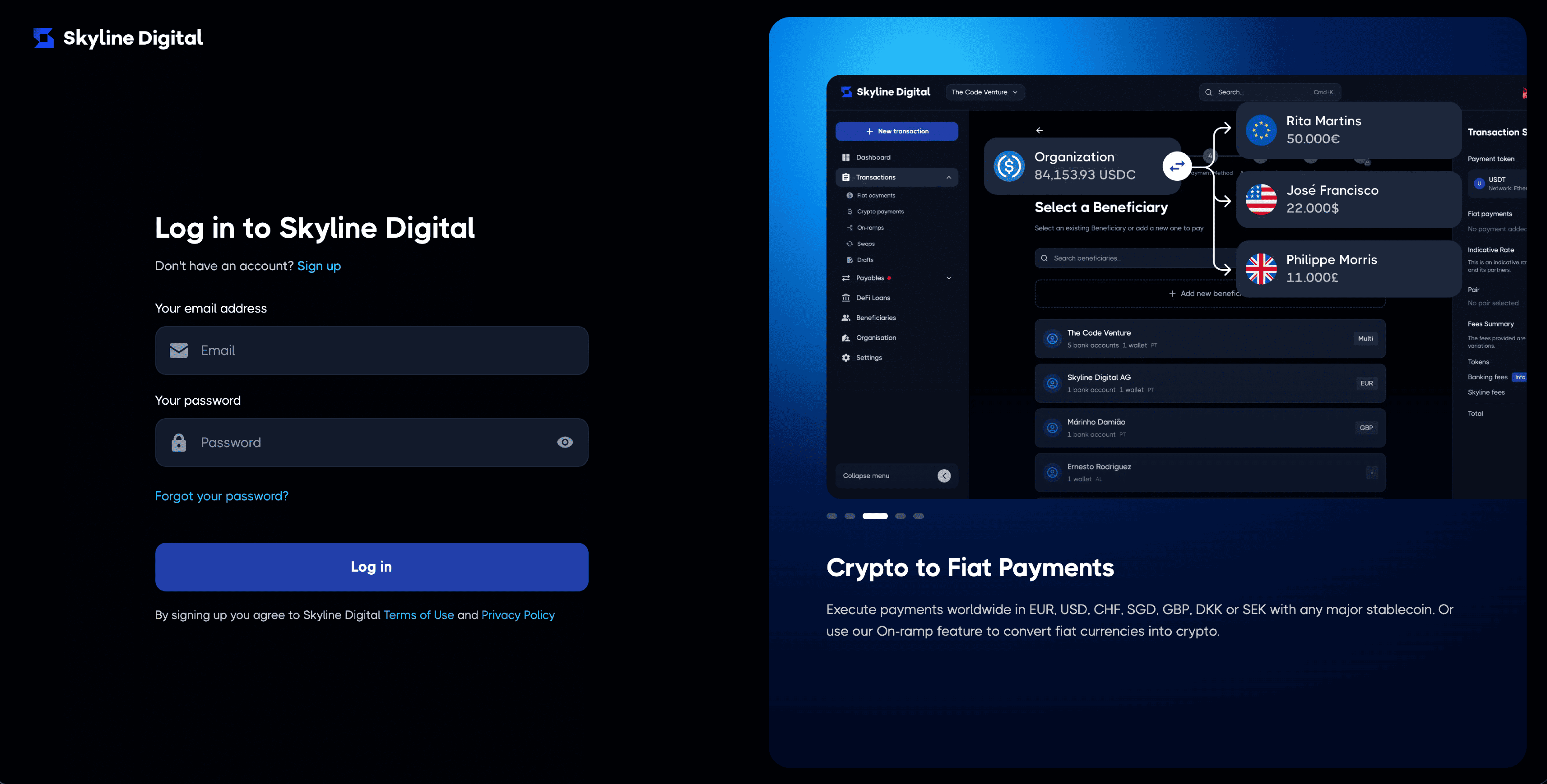
When a low-code bottleneck threatened to slow down Skyline Digital's ambitions in Web3 and global payments, the team turned to AI. What followed was not an experiment in automation for its own sake, but rather a focused engineering effort to modernise the product, improve performance and create a more scalable foundation for the future of crypto and fiat payments. We’ve interviewed André Fatia, CTO at Skyline Digital, about the impact this had on product quality, engineering velocity and client experience.
“Our frontend was originally built on a low-code platform because we wanted to accelerate our go-to-market. But as we’ve seen across the industry, these tools become a bottleneck when it’s time to scale: they’re inflexible, hard to collaborate on across a team, and increasingly expensive compared to hosting your own application”, explains André Fatia, Skyline Digital’s CTO.
As product development slowed, collaboration became more difficult, and improving the platform became a frustration point. The decision to go all-in on AI-assisted development didn't come from a boardroom slide, it came from the team’s experience.
“We had been experimenting with Claude Sonnet on a separate internal project called Nexis, and the productivity gains were immediately tangible, even before the more powerful Claude Opus model was available”, says André. The results were increased productivity and tangible enhancements to the platform. When Opus was launched, the team committed to rebuilding the entire frontend in Next.js with React.
However, not everything can be automated. AI was never treated as a substitute for developers. It was used as a tool to help skilled engineers move faster, work more efficiently and iterate with greater precision. “AI tools are a force multiplier for our team. They magnify both our productivity and the depth of what we can deliver. That means a better product, faster iteration, and significantly improved bug fixing and support. For a company building financial infrastructure, being able to move quickly without sacrificing quality is everything”, adds André.
That distinction matters. Although AI can accelerate development, it still requires engineering judgment, human review, and disciplined testing. In practice, value comes from combining strong technical knowledge with careful oversight.
Working with AI on every layer
Since this was the second time building the product, the team already knew what to expect and had all the context. From the API code to the existing application logic and user flows, everything was already in place. This made the transition far smoother than building from scratch. “The AI wasn’t starting blind. It was working from a well-defined foundation, which is where it performs best”, conveys André.
Furthermore, the AI's involvement extended beyond writing code. It touched every layer of the development process:
Design
The team provided the model with screenshots of the existing application so it could absorb Skyline Digital's visual language before generating new interfaces.
Code generation
The AI worked directly from Skyline Digital's API specifications, producing frontend logic that mapped cleanly onto an already well-defined backend.
Internal tooling
The AI also helped improve Skyline Digital's internal logging and notification systems, workflows that are easy to deprioritise but matter enormously at scale.
Crucially, the core backend infrastructure remained untouched. The AI only rebuilt only the frontend layer, not the underlying architecture. This separation provided a safety net throughout the process and kept the risk surface small.
Overcoming obstacles and guaranteeing security and stability
In financial infrastructure, speed is valuable, but trust is essential. For Skyline Digital, this meant that AI-generated code could never bypass the standards applied to any other development workflow.
For André, “the biggest misconception is that AI does everything for you, it doesn’t”. As he puts it, “AI still hallucinates, generates unnecessary code, and can produce underperforming solutions if you’re not careful. The key is to treat AI as a powerful collaborator, not as autopilot. Our team focused heavily on manual testing and built a tight feedback loop: test, catch bugs, feed them back to the AI, and iterate. That discipline is what made it work.”
Every piece of AI-generated code underwent human review before being merged. Skyline Digital maintained the same code review standards and testing processes it would apply to any development approach.
Simultaneously, the team ensured that the existing API and backend architecture remained intact. AI was rebuilding the frontend on a stable, proven foundation, providing the team with a safety net throughout the process. As it turned out, this is also where AI performs at its best: when it has rich context to work from rather than starting cold.
The Results: a platform 5 to 10x Faster
The most immediate improvement is performance: the platform is now 5 to 10 times faster than before.
For clients, this means a smoother and more responsive experience. For the internal team, it means an equally important improvement: a codebase that is easier to maintain, improve and scale over time. “We’re significantly more agile now. We’re compounding speed gains over time, not just on day one”, concludes André.
For Skyline Digital's clients who manage payments, treasury, and digital assets, this rebuild means they get a better, faster, more modern product today and a faster pace of improvement going forward.
The limits of its original tooling no longer constrain the platform. We're now building for where Skyline Digital is heading in the future.
This article was written by Skyline Digital for educational purposes only and does not in any way constitute investment advice.
Sign up now
Ready to soar in the digital realm? 🚀 Join Skyline Digital now and unlock a world of limitless possibilities.
Join nowGot any question? Contact us
.png)
.png)